Contracting Is a Work Arrangement, Not an Industry
Role extraction over the industry-blind contractor index shows Doctor as the no. 2 contract role on live briefs, ahead of every software title. Software Developer sits at no. 8. Only 4 of the top 12 contract roles are IT roles, and the deepest non-IT contract markets are decades old.
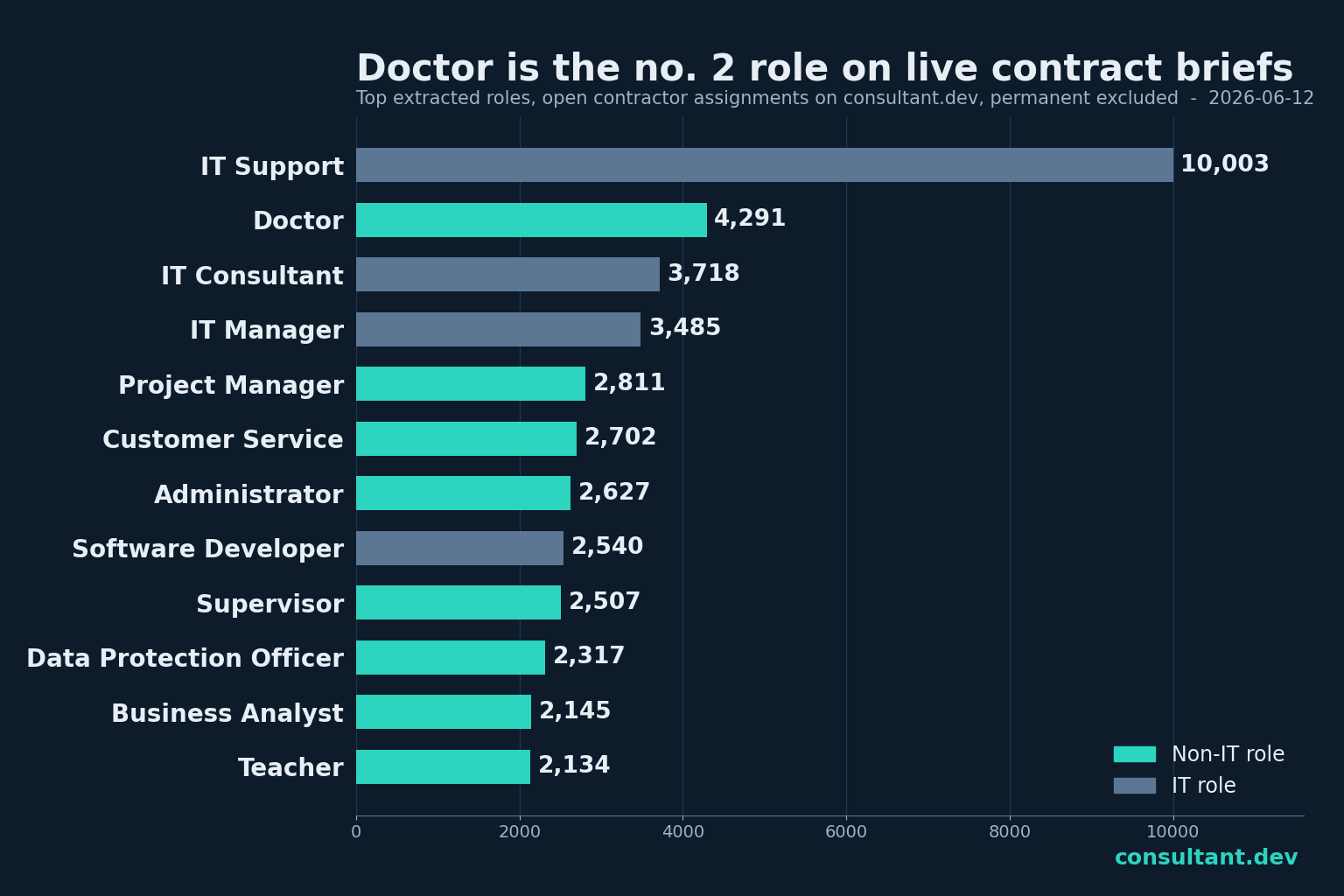
TL;DR: Role extraction over the industry-blind contractor index on consultant.dev shows Doctor as the no. 2 contract role on live briefs, ahead of every software title. Software Developer sits at no. 8. Only 4 of the top 12 contract roles are IT roles. The deepest non-IT contract markets are mature and decades old: US locum medicine and UK supply teaching.
Ask someone to picture a contractor and they will usually describe a software developer. Contract-work platforms reinforce that: most aggregators index IT briefs and stop there.
consultant.dev indexes by work arrangement instead. Anything published as a contract, interim, locum or freelance engagement goes in, whatever the industry. Role extraction over that industry-blind index gives a direct answer to a simple question: what does the contract market actually hire?
The answer is not "developers".
The top contract roles on the live index
Across live contractor briefs with an extracted role, the most frequent roles today are:
| Rank | Role | Briefs |
|---|---|---|
| 1 | IT Support | 10,003 |
| 2 | Doctor | 4,291 |
| 3 | IT Consultant | 3,718 |
| 4 | IT Manager | 3,485 |
| 5 | Project Manager | 2,811 |
| 6 | Customer Service | 2,702 |
| 7 | Administrator | 2,627 |
| 8 | Software Developer | 2,540 |
| 9 | Supervisor | 2,507 |
| 10 | Data Protection Officer | 2,317 |
| 11 | Business Analyst | 2,145 |
| 12 | Teacher | 2,134 |
The number two contract role on the live index is Doctor. It outranks every software role, including Software Developer at number eight. Of the top twelve roles, four are IT roles in any strict sense; the other eight are not.
Where the non-IT contract market lives
The geography says where each market sits:
- Doctor: 3,873 of 4,291 briefs are in the United States, with the United Kingdom a distant second at 162. These are locum tenens engagements, sourced from staffing platforms built specifically for contract physicians.
- Teacher: 1,627 of 2,134 briefs are in the United Kingdom, the supply-teaching market.
- Administrator: spread across markets, led by the United Kingdom at 623 and the United States at 222.
This is not a gig-economy novelty. Contract staffing was institutionalized in these fields decades ago: locum tenens medicine in the United States, supply teaching and interim administration in the United Kingdom. These are mature, regulated contractor markets with their own agencies, rate structures and compliance regimes. They predate the word "freelancer" being attached to laptops.
What changed is visibility. A locum physician taking a two-week assignment in Texas and a freelance DevOps engineer in Berlin are doing the same thing structurally: selling defined-scope work at a day or shift rate without an employment contract. Only one of them has historically had aggregators, rate benchmarks and demand data built for them.
What this means if you contract outside IT
Two practical takeaways.
First, if you are a locum doctor, supply teacher, interim administrator or freelance project manager: the demand side of your market is large, liquid and searchable, and you should treat it the way IT contractors treat theirs. Compare engagements across agencies before accepting a rate. The spread between agencies for the same shift class is real money.
Second, if you run an agency or buy contract labour outside IT: the talent side increasingly behaves like IT contractors. They compare. Listings with a stated rate and a defined scope draw the response; listings without them are filtered out.
Caveats
Role labels are NER-extracted from brief text and currently resolve on roughly a fifth of the live contractor index, so absolute counts undercount each role and the table should be read as a ranking, not a census. Extraction recall differs by language and source formatting, which can shift relative positions a few places. The index excludes permanent positions entirely; it does not exclude any industry.
Methodology
Numbers are taken from the consultant.dev live index on 2026-06-12, filtered to contractor employment only (permanent positions excluded), aggregated on the extracted role field. Country splits use the per-brief country field.
Closing
"Contractor" describes how you work, not what you work on. The data says the contract market agrees: locum medical lists and supply-teaching days sit right next to sprint-scoped development work, and in volume terms they are often ahead of it.
Search live contract assignments across every industry on consultant.dev →
Related guides

IT Contractor Market in Numbers: What 215,000+ Briefs Actually Show
consultant.dev indexes over 215,000 IT contractor briefs from 600+ sources across 120+ countries. The top 3 sources supply under 14% of live briefs. Switzerland holds 1 in 8 globally. Roughly 3% of briefs mention AI or machine learning.
Read article →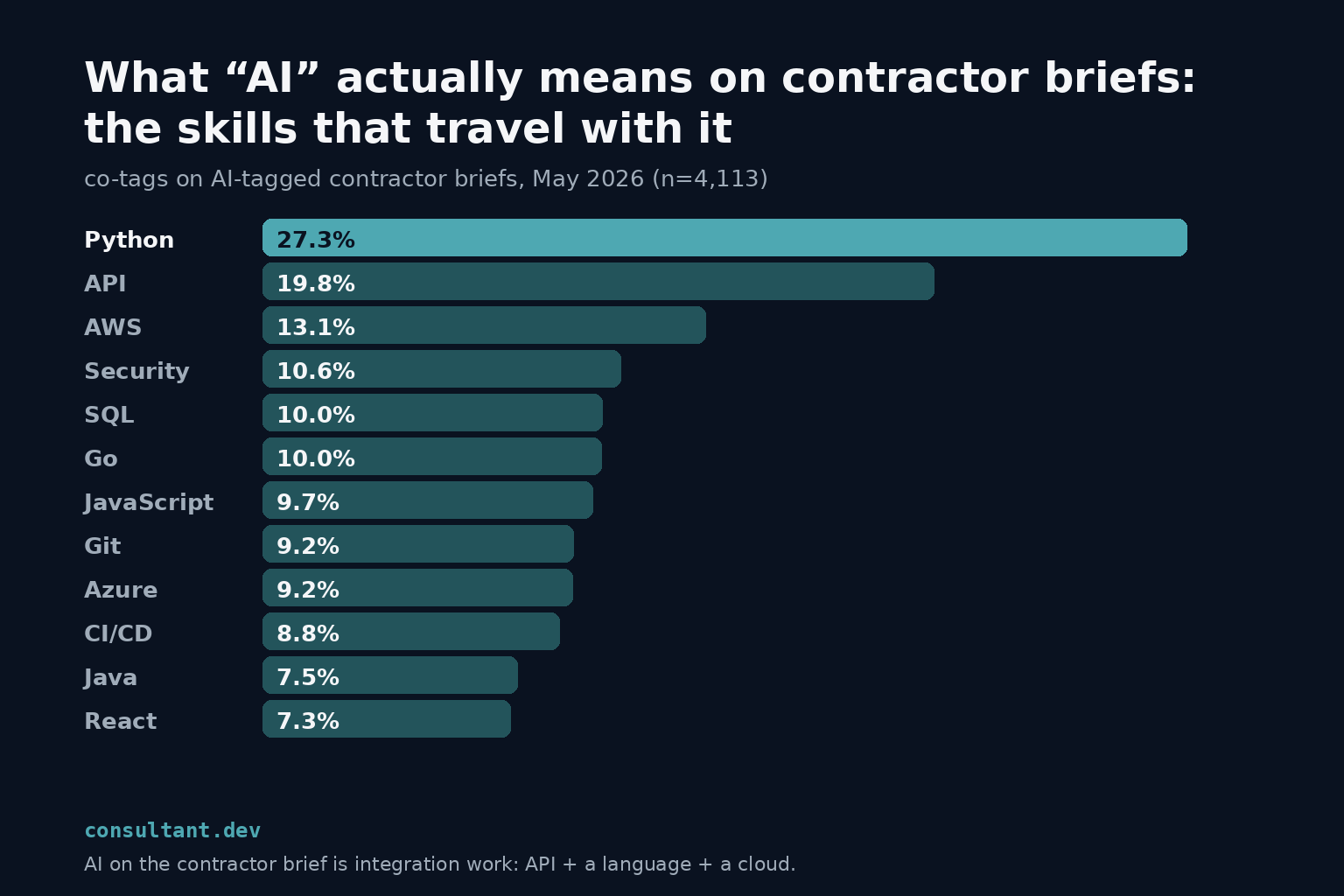
What AI Actually Means on Contractor Briefs, the Skills that Travel with It
One in ten live IT contractor briefs tag AI, Machine Learning, or generative AI. The real ask is not AI alone. Python appears on 27% of AI-tagged briefs, API on 20%, AWS on 13%. Security outranks every cloud platform individually. The hireable AI contractor stack is infrastructure and integration, not model research.
Read article →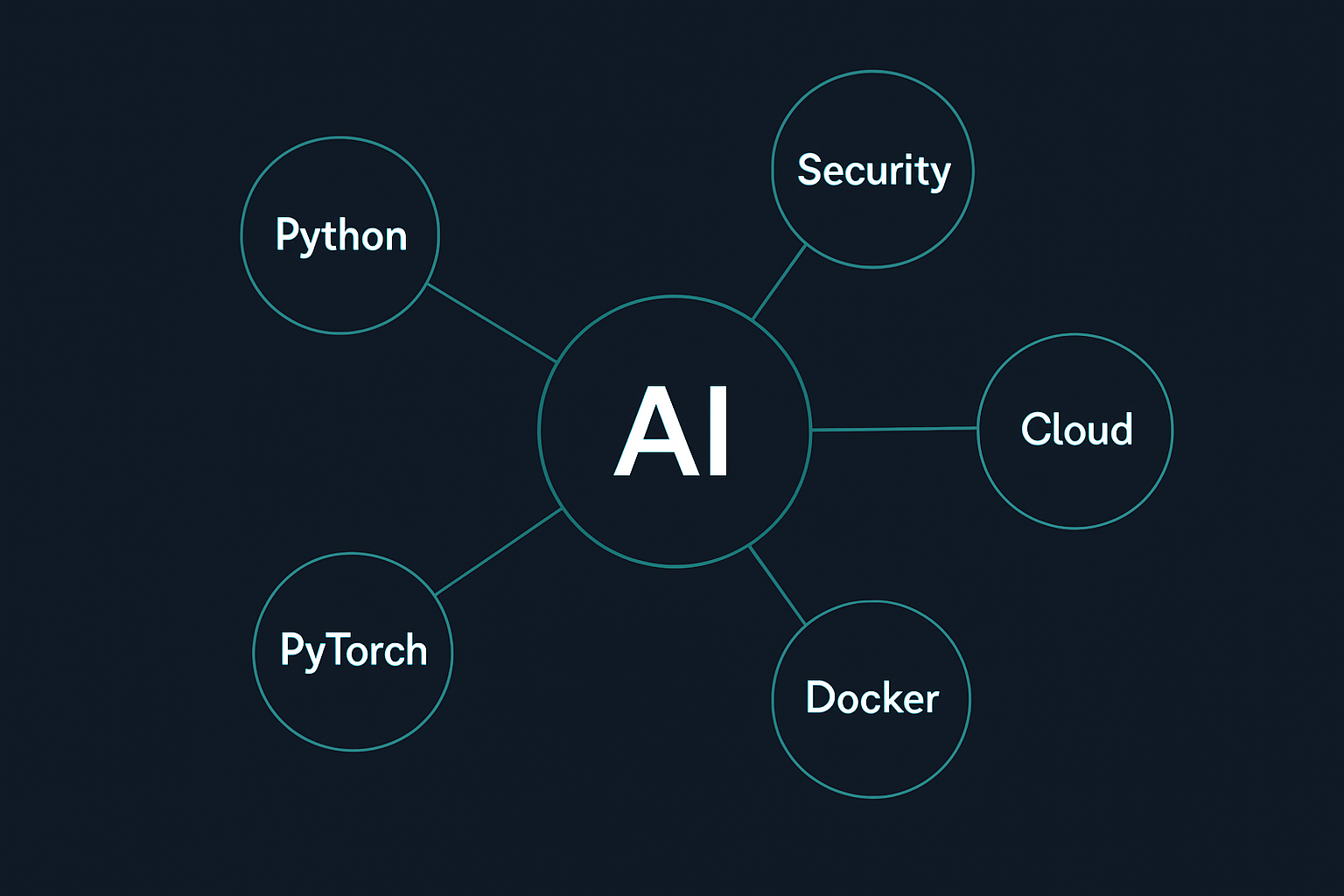
AI Is Now the Baseline. The Brief Tells You What It Pairs With.
2,153 live AI/ML contractor briefs analyzed. Python pairs with 53% of them. But the real signal is in the three clusters -- model builders, cloud deployers, security-of-AI -- and what each one means for how many contractors you compete against.
Read article →